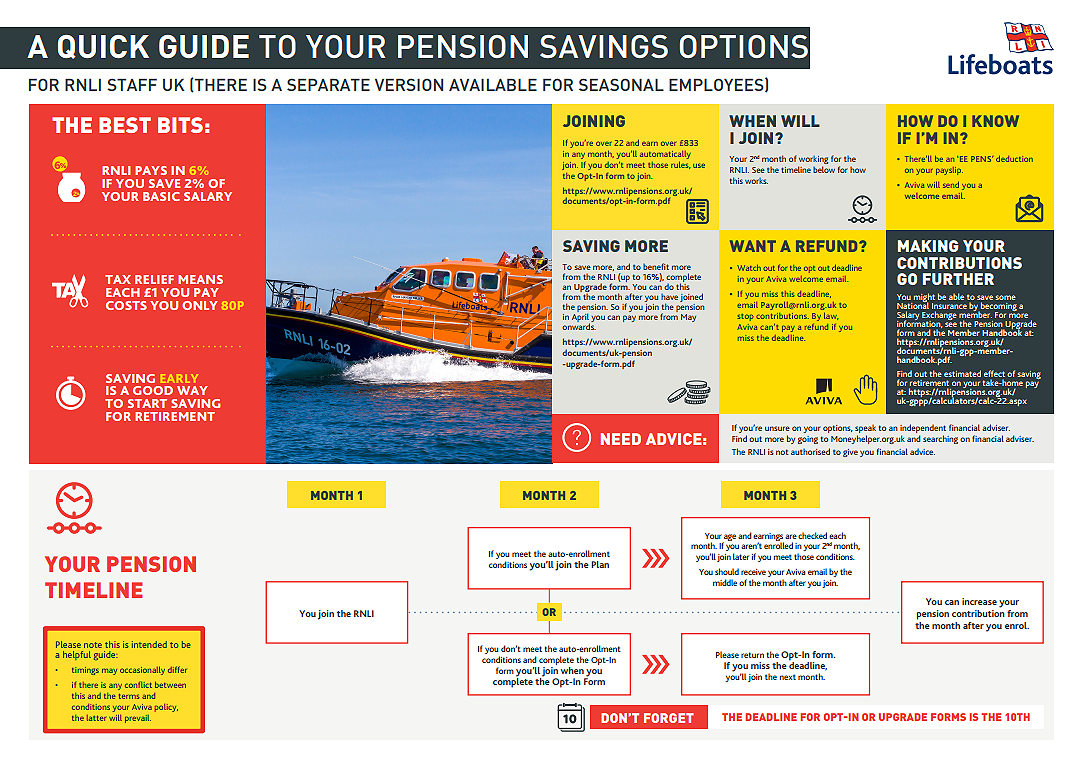
If you live and work in the UK, then you can join the RNLI Group Personal Pension Plan. Your age and earnings are assessed when your second month's pay is processed. You will join the Pension Plan without completing a form if you meet the age/earnings thresholds. This is Automatic Enrolment. Complete an Opt In form to join the pension scheme if you are not automatically enrolled.
View your pension
My Workplace Aviva app
Watch the My Workplace Aviva app video:
Download the My Workplace app to check your pension pot easily. Find out more here.
Pensions saving – costs you less than you think
Wondering whether it’s worthwhile to join an RNLI pension? Use the calculator to see how your contribution, the RNLI’s and tax relief add up.
These calculators are for contributory members (non Salary Exchange) members.
Use the Shape my Future tool to help you estimate what you need to save for your future – currently this assumes an ‘annuity’ is used. Shape my Future
MoneyHelper
Impartial information and tools to help you manage your money moneyhelper.org.uk
Pension Wise
A free and impartial government service that helps you understand the options for your pension pensionwise.gov.uk
GOV.UK
UK government information on pensions and retirement planning GOV.UK
You can choose whether you contribute the minimum amount to your pension or you can increase how much you put into your pension. If you put in more than the minimum, so will the RNLI. If you are a salaried employee, you can become a Salary Exchange member. This will save you and the RNLI some National Insurance each month. The member handbook explains how Salary Exchange works and the difference between Salary Exchange and Contributory members.
Salary Exchange reduces the National Insurance both you and the RNLI pay
This means your take-home pay is slightly higher and RNLI can direct the savings that we make to frontline services. The UK Member Handbook explains how Salary Exchange works. Salary Exchange is available to salaried UK pension members.
Contributory members can claim back higher-rate tax via your self-assessment tax form
If you are a contributory member of the RNLI DC Scheme, you can claim additional tax relief if you are a higher rate tax payer. Read
UK GPPP, claiming back higher rate tax relief for more information.
Need help with transfers?
If you want to know if it is in your best interests to transfer an existing pension into your Group Personal Pension, contact People Admin for a self-explanatory Transfer Pack. If you have one or more pensions that you might want to transfer in to the RNLI Group Personal Pension Plan, follow the step by step guide.
You are in control
You can decide how the money in your policy is invested from a wide range of options including a default investment fund.
Contributions
The RNLI makes a contribution to your pension, depending on the percentage of your pay that you want to either exchange for an additional RNLI pension contribution (salary exchange member) or contribute to your pension (contributory member). Full details on contribution levels can be found in the Member Handbook.
Tax relief for contributory members
The cost to you of being in the Plan is reduced because you receive tax relief on your contributions. The contribution you pay is reduced by an amount equal to the basic rate of income tax when deductions are made from your pay. Your pension provider will then increase the actual amount invested to reflect the full contribution.
If you are a higher rate tax payer you can claim additional tax relief.
2014 Budget
You can find out more about the additional flexibility the 2014 Budget brings for your pension savings here.
Benefits when you need them
You can take some or all of your benefits from the Plan at any time between the ages of 55 and 75 – and you don’t need to stop working before you draw your benefits.
Options available to you at retirement
Currently you can take up to 25% of your fund value as a tax-free cash lump sum. The rest of your fund will be used to provide an income for you, either by buying an annuity or by drawing income from your fund, which you can adjust to suit your personal circumstances at that time.
Your Expression of Wish form…
…is used to nominate who you wish to benefit from your fund and from your life cover, if you die before you retire. Don’t forget to update it if your circumstances change – it’s a good idea to do this at least every five years. See the Life Cover section, on this pension website's home page, for information about how pensions and life cover payments work if you die.